Nordic Walking: Technique, Equipment and the Evidence
Nordic walking is a defined movement, not walking with accessories. The pole is planted at an angle behind the body and pushed backwards, and everything else follows from that one detail: the length of the pole, the construction of the strap, the training effect. These pages take the movement apart phase by phase and cover the equipment, the certification landscape and the measured effects with figures rather than promises.
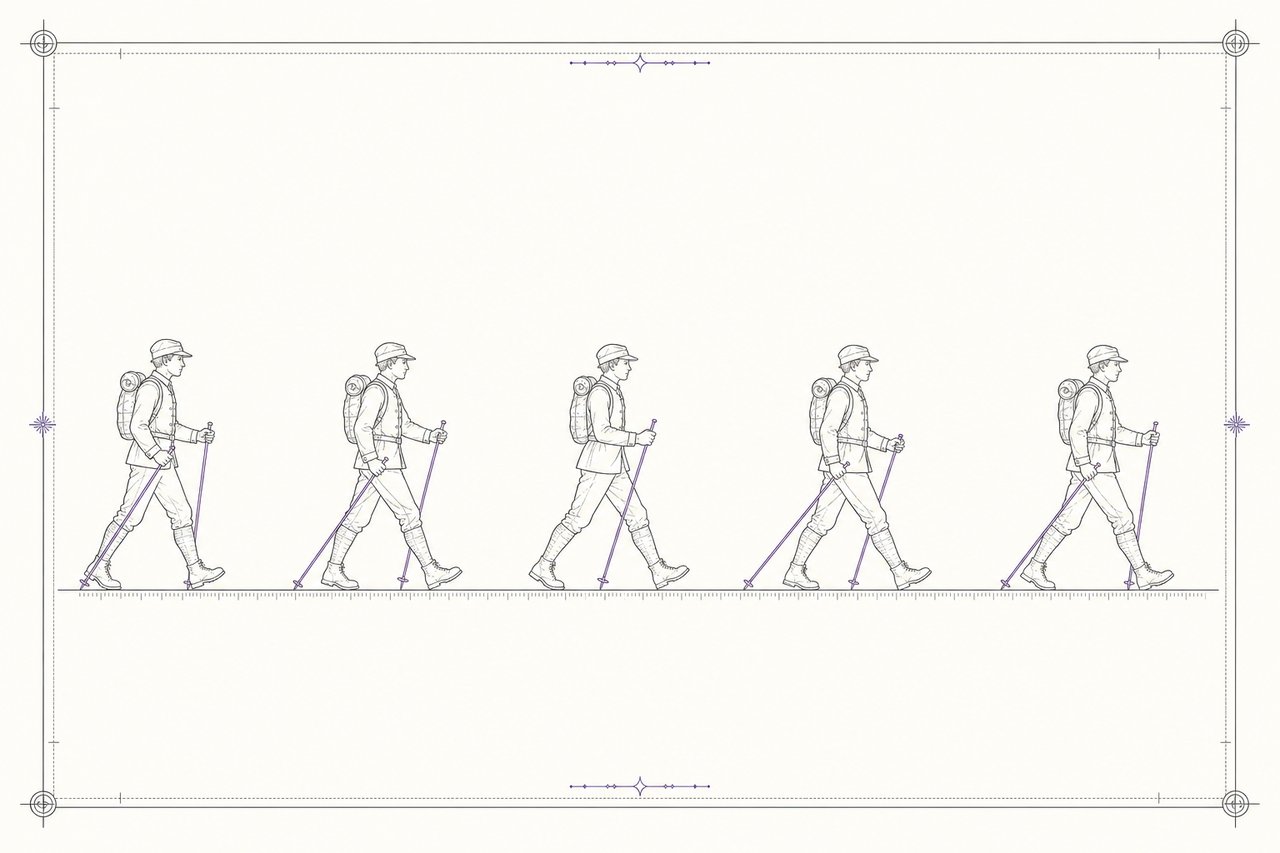
The stride, phase by phase
The diagonal stride is taken from cross-country skiing: right arm and left leg travel forward together, then the sides swap. Broken into phases, the third and fourth carry the entire effect. The first two bring the pole into position and the last returns the arm.
-
The tip meets the ground at an angle behind the leading foot. The arm stays slightly bent, the hand closed.
-
The body travels over the planting point. The elbow starts to open and pressure builds through the strap.
-
The working phase. The arm extends fully behind the body and the trunk rotates slightly against the legs.
-
Behind the hip the hand opens completely. The pole hangs in the strap and swings through.
-
The arm swings forward loosely. The hand closes again just before the next plant.
If the arm stops short at phase three, the pole is only ever placed and lifted, and the shoulder and trunk muscles take no part. The stride then looks correct and is not. This is the single most common fault, and it is also the reason published figures for energy expenditure vary so widely: studies that trained technique first report far larger effects than those that did not.
Equipment: pole, strap, shoe
There are only four things to decide, and they matter in a specific order. Length follows body height and determines the elbow angle at the moment of planting, which decides whether the push phase happens at all. Shaft material governs weight and how much vibration reaches the elbow, with a higher carbon content damping more than plain aluminium. The strap carries the load once the hand has opened, which is what distinguishes these poles from trekking poles. The tip, with its removable rubber buffer, matches the pole to the surface.
Buyers routinely reverse that order, because shaft material is the most prominent figure on the label and the strap is the hardest thing to judge online. Two checks are worth making in person: whether the strap sits without pressure on the base of the thumb, and whether the grip stays put when the hand opens.
Starting out
The sensible first session begins without using the poles at all. Walk with them trailing so the arm finds its full swing, and only then add pressure. That order separates timing from force, and it is why classes open with an exercise in which apparently nothing happens. Starting at full effort instead sets a shortened arm action that is harder to correct later than it would have been to learn properly.
A realistic first month is three sessions a week of half an hour, on flat surfaced paths, with the technique checked once against a reflection or a short video from the side. Terrain and duration come afterwards. The soft surfaces and hills that make a session harder also make faults harder to see.
Sections
- 01 Technique
The diagonal stride, its five phases and the faults that set in.
- 02 Poles
Length, material, grip and strap: what actually separates the equipment.
- 03 Associations
Governing bodies in German-speaking Europe and the routes to an instructor licence.
- 04 Nordic Skating
Nordic blading and offroad skates: the rolling variants of the discipline.
- 05 XCO Training
Reactive dumbbells, swinging mass and what of it is evidenced.
- 06 Health
Effects on the back, circulation and energy expenditure, with figures.
Frequently asked questions
How is this different from walking with trekking poles?
The difference is in the direction of force, not the equipment. A trekking pole is planted ahead of the body and supports: force runs down into it. A nordic walking pole is planted at an angle behind the body and is pushed backwards: force runs out of it. That single distinction explains the shorter length, the load-bearing strap and the angled tip.
What length should the poles be?
Body height multiplied by 0.66, rounded to the nearest available length. At 175cm that gives 115cm. Poles are sold in 5cm steps, so precision beyond that is meaningless. Anyone still learning the movement should take the shorter of two adjacent lengths, because an over-long pole prevents the arm extending behind the hip.
Is it easier on the joints than running?
Substantially. Running loads the knee with roughly two to three body weights per step and walking with about one; the poles remove part of that again. Energy expenditure rises above plain walking at the same time, because more muscle is involved. That combination is why the discipline is used in rehabilitation.
Do I need special shoes?
No, but the sole has to be flexible enough to allow a roll through the ball of the foot. A stiff hiking boot blocks exactly that movement. On surfaced paths an ordinary running shoe is enough; off road, a trail shoe with tread.
How often should I train?
Three sessions of 30 to 45 minutes a week is the lower bound at which endurance effects become measurable. In the first weeks technique matters more than duration: half an hour with a clean arm action does more than an hour of dragging the poles.
What is the difference between nordic walking and nordic fitness?
Nordic fitness is the wider term. It covers the pole disciplines and the training forms derived from them, including rolling variants and reactive training devices. Nordic walking is the original and by far the most widespread part of it.
Where did the discipline come from?
From cross-country skiing, as summer training. It was systematised in Finland in 1997 and reached German-speaking Europe around 2000, where the first training structures formed shortly afterwards. That origin explains why the movement mirrors the classic skiing technique.
How do I tell whether my technique is wrong?
Two signs are reliable. If the pole is planted in front of the body, every plant brakes rather than drives. If the hand stays closed behind the hip, the arm never extends and the push phase is missing. Both are visible in your own shadow or a shop-window reflection.