Nordic Walking Poles: Length, Material and Straps

Four decisions, and only one of them can be calculated. Length follows body height; shaft, strap and tip are trade-offs, and only two of them are noticeable while walking. What follows orders them by the influence they actually have on the movement rather than by the space they occupy in product descriptions.
Pole length by body height
Pole length 115 cm
Guide value using the 0.66 factor. Poles are sold in 5cm increments, so the figure is rounded to the nearest available length.
The four parts
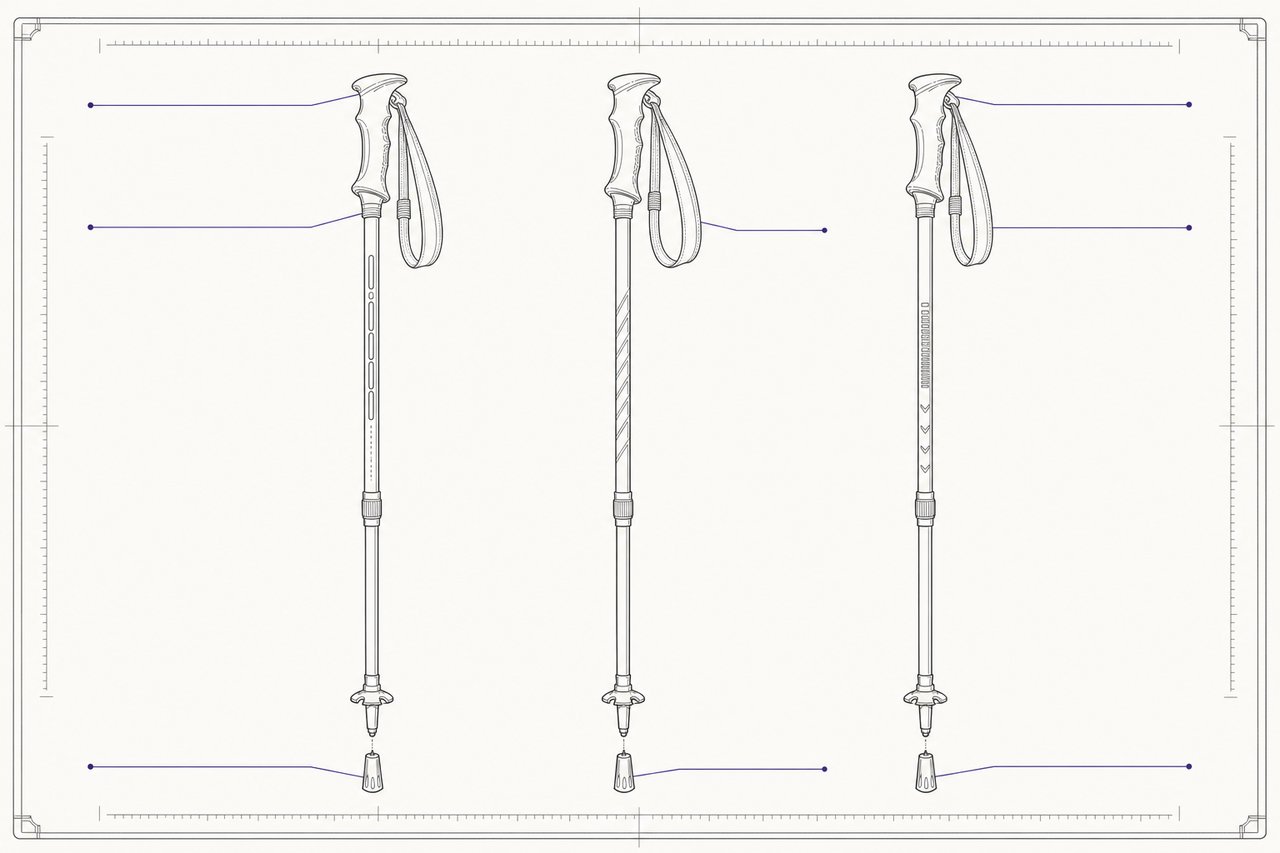
Length follows body height with a factor of 0.66, rounded to the nearest available step. It sets the elbow angle at the moment of planting and therefore decides whether the push phase happens at all. The shaft governs weight and vibration. The strap transfers the load the instant the hand opens, which is the part that distinguishes these poles from every other kind. The tip, with its removable rubber buffer, matches the pole to the ground.
Length matters most and the strap second. Buyers routinely reverse the order, because shaft material is the most prominent number on the label.
Aluminium, carbon and the mixtures
Aluminium is tough, cheap and forgiving of sideways load: it bends rather than breaking. It also passes vibration more or less unfiltered into the elbow, which tells on long stretches of tarmac. Carbon damps noticeably better and saves roughly 100 to 150 grams per pair, but reacts less kindly to point impacts.
The common mixtures sit between 30 and 80 per cent carbon and cover the sensible range. For everyday use a pair at around 60 per cent is the least conspicuous choice: damped enough for tarmac, robust enough for woodland. Pure carbon repays itself mainly at high weekly mileage on surfaced routes.
The strap, in detail
The strap is the least examined part and the one that separates this discipline from every other pole sport. Its job starts the moment the hand opens behind the hip: from then on the pole hangs from it alone, and the whole force of the push runs across the base of the thumb and the back of the hand.
Testing it takes seconds. Put the hand in, let go of the grip, extend the arm backwards. If the pole hangs in line with the arm without the strap cutting into the thumb, it is adjusted correctly. If the grip tips away or the hand slides forward, it is too loose or twisted.
Tips, buffers and the ground
Under every rubber buffer sits a hardened tip, and each is meant for a different surface. On tarmac the buffer stays on; the bare tip would slip, ring and wear faster than the rubber. On woodland ground, gravel, grass and snow the buffer comes off, because only the tip finds purchase.
The buffer is a wear part, good for roughly 300 to 800 kilometres. You notice it not by appearance but by behaviour: as soon as the tip skids when planted at an angle on tarmac, the rubber is worn or unevenly ground down. Check too that replacement buffers and baskets can be bought separately, because on some cheaper models they are bonded in place, and then the wear part is the end of the pole.
Frequently asked questions
Fixed, adjustable or folding?
For regular use on the same routes a fixed shaft is the first choice: lighter, stiffer and with no clamp to fail. Adjustable poles earn their keep when several people share one pair. Folding poles solve a transport problem and pay for it in weight at the joints.
How much carbon is worth paying for?
Above roughly 60 per cent the difference in vibration damping on tarmac becomes clearly noticeable. Between 80 and 100 per cent the gain is small and the price difference is not. Pure carbon is also more sensitive to sideways impact, for instance when a tip catches between stones.
What exactly does the strap do?
It transfers the force of the push once the hand has opened. Without a functioning strap the pole would have to be gripped, which makes the wrist work against the resistance. A glove-style strap with a fastening spreads the load better than a plain loop but is handed and usually brand-specific.
Rubber buffer or metal tip?
Both, depending on the surface. On tarmac and firm paths the buffer stays on, because the metal tip slips and is noisy there. On woodland ground, gravel and snow the tip grips. Buffers are wear parts and last roughly 300 to 800 kilometres.
Will trekking poles do?
Only up to a point. They are usually longer, heavier and carry a strap designed for support rather than propulsion. Anyone using the full arm action notices the difference in the push phase immediately.
What should a usable pair cost?
The lower usable limit is around 50 to 60 euros for a fixed aluminium-carbon pair with a decent strap. Below that the savings are usually made on the strap and the tip mounting, which are precisely the two parts that transmit the force.
Does the length have to be exact?
Within five centimetres is enough, because retail sizes step in fives anyway. If you fall between two lengths and are still learning, take the shorter one: it leaves the arm more room to extend behind the hip.
What about children and very tall walkers?
For children the 0.66 rule is impractical, because height changes faster than poles can sensibly be replaced; this is the one good reason to buy adjustable. Above roughly 195cm the calculation produces lengths that are not reliably stocked, and the options are an adjustable model near its upper limit or a cross-country pole fitted with a suitable strap.