Nordic Skating: Technique, Offroad Skates and Kit

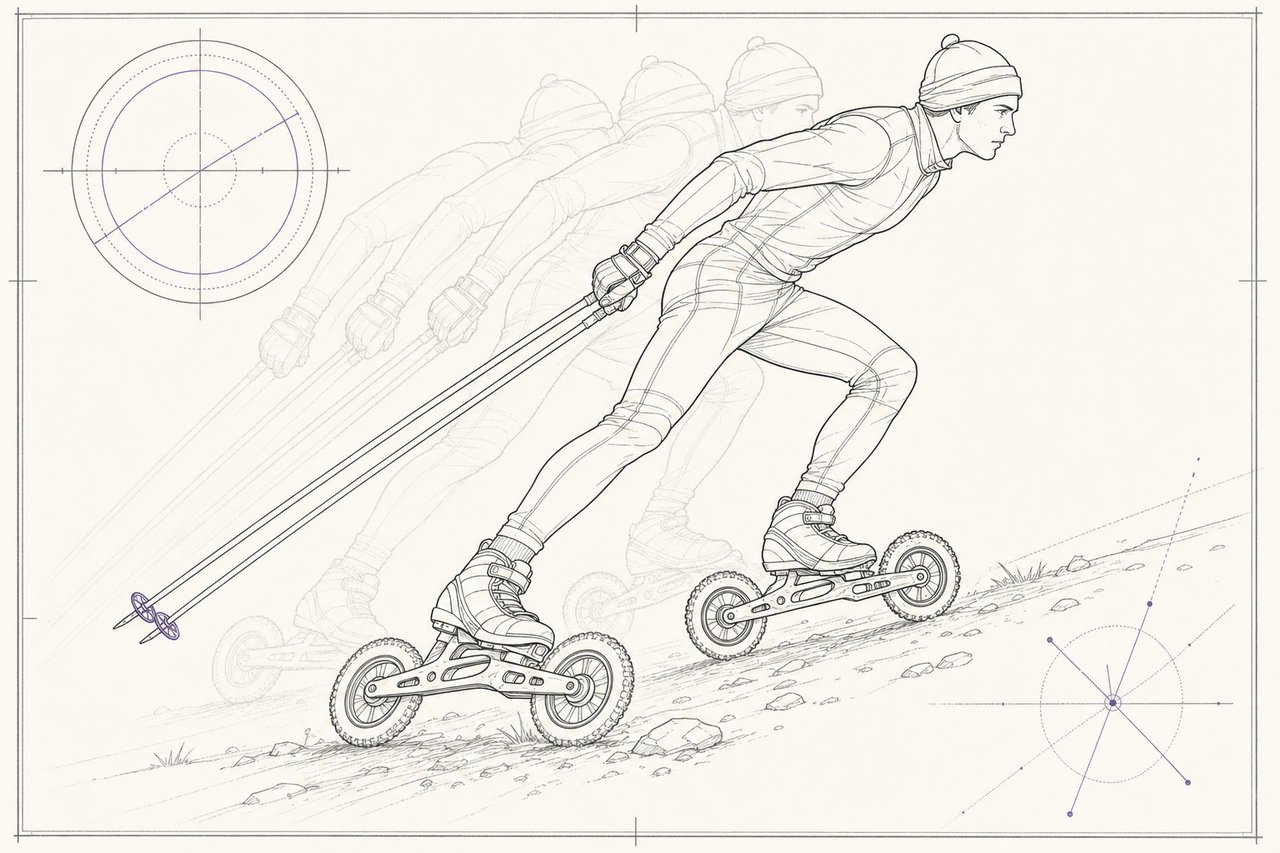
Offroad skates turned an asphalt activity into an off-road one. Nordic skating is the collective term for rolling with poles, and it shares only the poles with walking, not the movement. Instead of pushing backwards the skater pushes sideways, and the poles usually work as a pair rather than alternately.
Origin and how it differs
Like walking with poles, the discipline comes from summer training for cross-country skiers. Rolling mirrors the skating technique of the sport while walking mirrors the classic one. From that follows the essential difference: here the ski is set out to the side and pushed against, there the movement runs straight ahead in the track.
For anyone arriving from walking, two things change. The push is shorter and harder, and the balance sits on a narrow rolling base. Both can be practised separately: rolling without poles first, then the double-pole action from standing.
Braking is the real barrier
Setting off takes minutes to learn, stopping takes hours, and that decides which routes are usable. The snowplough turns both wheels inward and brakes on the edges; it needs width and a smooth surface. Linked turns bleed off speed through direction changes and are the realistic option on narrow paths. A mechanical brake, operated by a cable at the grip, acts on a drum or a magnet.
What does not work is braking with the poles. They are built for backward pull, not forward compression, and a shaft caught between the ground and your body weight will break. If a descent exceeds your braking method, walk it. That is part of the technique, not a failure of it.
Choosing kit for the route
The equipment follows the route, not the other way round. On smooth asphalt, disused railway lines and wide embankment paths, the narrow setup with 90 to 100mm wheels is faster, lighter and quieter. As soon as joints, root damage or loose grit appear, that advantage reverses, because small wheels catch on every edge.
On gravel forest roads the large pneumatic tyres are the only workable option. They cost weight and inertia in return: an offroad pair weighs several times an inline pair, and setting off takes noticeably more effort.
One kit detail is usually noticed only after a first fall: the hand must be able to leave the pole. A fixed closed strap holds the hand while the body rotates, and the shaft then acts as a lever on the wrist. Release systems from cross-country skiing are the sensible choice here.
Frequently asked questions
How hard is the switch for inline skaters?
The rolling part transfers, the pole work does not. Skaters already have the sideways push and the balance but must learn the double-pole action from scratch. The reverse is harder: pole work without rolling experience regularly ends with the poles being used as brakes, which is not what they are for.
What wheel size do I need?
On asphalt, 90 to 100mm is usual. For unsurfaced paths sensible sizes start at 125mm, with 150 to 200mm common. Larger wheels roll more calmly over irregularities but demand more effort to accelerate and raise the centre of gravity.
How do you brake without a heel stop?
By snowplough or by linked turns, as on skis. Many offroad models add a drum or magnetic brake operated by a cable at the grip. Relying on the poles is the most common beginner error and the main cause of broken shafts.
Are the poles the same as for walking?
No, they are longer. A factor of roughly 0.84 to 0.89 of body height is usual, against 0.66 for walking, because the trunk works further forward. Fixed-length cross-country poles are used, with a tip that grips on asphalt.
What is nordic blading?
Effectively the same movement, usually on classic inline skates with smaller wheels and on asphalt. The term was more widespread in German-speaking Europe for a period and is used less often now.
What protection is genuinely necessary?
Helmet and wrist guards make the largest difference in injury statistics. Knee and elbow pads are sensible but secondary. Note that wrist guards with a long splint can interfere with the pole strap, which is why short-splint models exist.
Can I use woodland paths?
Firm gravel forest roads yes, soft woodland floor no. The limit is set less by the surface than by the size of the stones: fine compacted gravel is rideable, coarse broken stone stops even large wheels. Roots across the direction of travel are the real exclusion criterion.
How does the load compare with running?
Impact loading essentially disappears, because there is no landing. Muscular load is correspondingly higher in the upper body and trunk. For joints the rolling variant is gentler; for the cardiovascular system at the same speed it tends to be more demanding.